

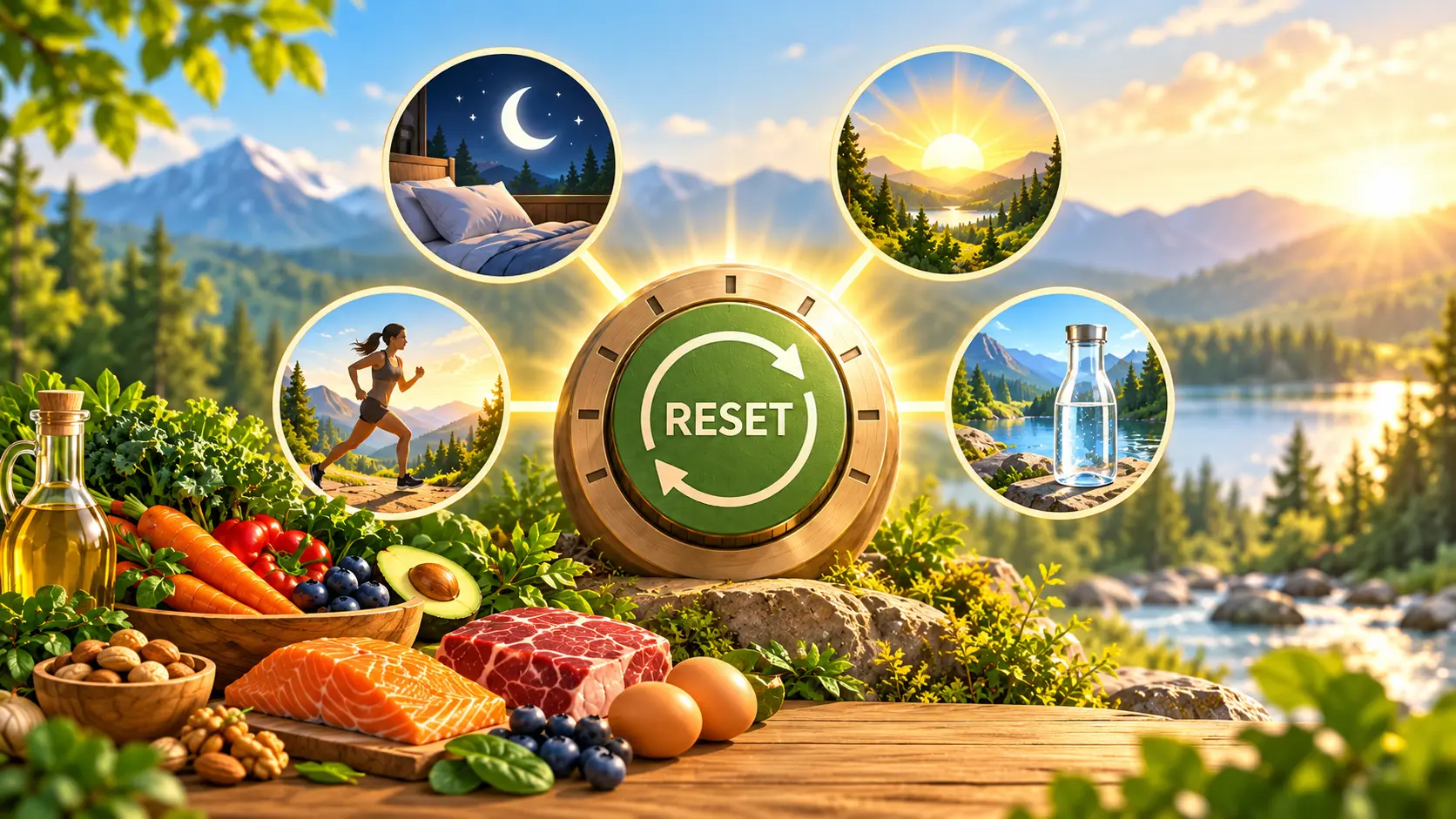
The key to health. Humans are designed to spend a large part of our days in the great outdoors… Surrounded by nature… Soaking up sunlight… Breathing fresh air… Eating off the land… Drinking fresh water. We are not designed to spend all day indoors with artificial light, stale air, ultra-processed foods, and contaminated water.
Our human factory settings: Nutrition. Sleep. Breathing. Movement. Light. Nature. Minimized toxins.
I don’t propose that we leave our homes to return to living out in the wild and in caves. While it would no doubt be good for every one of the factory settings listed, it is not realistic and brings its own set of dangers. What I do propose is that we be intentional about adherence to our factory settings the best we can within the comfort and convenience of our modern environment.
More resources:
- The book Good Energy by Dr. Casey Means, MD
- The book The Metabolic Scam by Joshua Hackett, MD
Nutrition
Eat all foods as close to their natural state as possible. High points here. Deeper dive in my Nutrient Dense Anti-Inflammatory Diet blog.
Our dietary factory settings are to eat off the land.
- Eat all foods as close to their natural state as possible.
- Natural, nutrient dense foods.
- Plants grown in fertile ground, absorbing the micronutrients from the soil.
- Animals eating their natural diets, raised in suitable living conditions.
We are not designed to eat manmade food-like substances and altered foods.
- Not bulk crops grown in dead, nutrient-depleted ground.
- Not foods that have been sprayed with and absorbed toxic pesticides like Glyphosate (Round Up).
- Not meat/dairy/eggs from animals bulk farmed in crappy living conditions being fed grains that were grown in nutrient-depleted soil and bathed in Glyphosate, or farmed fish that has been raised in exceedingly poor living conditions.
- Not ultraprocessed Frankenfoods full of manmade artificial flavors, preservatives, dyes, emulsifiers, and unnaturally extracted seed oils. .
Do the best you can to get close to this factory setting, but don’t drive yourself crazy about it. Shoot for 90/10 (90% nutrient dense and awesome, 10% crappy but convenient). This is a good target, but start by just getting as close as works for you. 80/20…70/30…whatever. I’d like to think that my family is consistent 90/10, but if I’m being honest, we totally fluctuate. Travelling throws a wrench in things, busy phases of life, etc. We just do our best.
Some kickstarts: Start your own garden. Find a local farmer with regenerative growing practices, fill your deep freeze with their meat, and stock your fridge with their eggs. Buy from a local food co-op or farmers’ market. Buy organic, particularly with grains and the “Dirty Dozen” produce items.
More resources:
- Take a deeper dive in my Nutrient Dense Anti-Inflammatory Diet blog
- Dr. Mark Hyman, MD and his books, podcast, YouTube, website.
- I highly recommend the book Ultraprocessed People by British physician Dr. Chris Van Tulleken to gain a real world understanding of modern food and its effects on our health.
- The book Genius Foods by Max Lugavere
- The book The Wahls Protocol by Dr. Terry Wahls, MD
- The book Nutrition and Physical Degeneration by Dr. Weston Price, DDS
Sleep
Sleep is the true fountain of youth. It is during our deep and REM stages of sleep that our body and mind repairs from all of the stresses of the day. Without sufficient duration of these sleep stages, our operating system breaks down. The effects of this are acceleration of chronic diseases, anxiety, depression- a cocktail of things that are best avoided. Deep dive into understanding sleep in my blog.
Sleep factory settings are based around natural light and a stable airway:
- The full range of wavelengths of sunlight throughout the day, particularly at sunrise and sunset, are absorbed by our skin and eyes, giving our bodies the proper signals for appropriate sleep and wake cycles.
- Proper forward and outward development of the jaws and lower face for a robust airway behind them. Deeper dive into this in my Building Perfect Jaws blog and in my Airway Workout blog.
- Closed-mouth parasympathetic relaxed nasal breathing throughout the night. Deeper dive in my Nasal Breathing blog.
- Uninterrupted passage through 5 or 6 full sleep cycles each night, spending sufficient time in each of the stages (1, 2, 3, and REM).
- Wrapping up eating and exercise in line with the sunset to allow the body to devote its energy to restoration during sleep. This also allows for a lowered core body temperature in preparation for sleep.
Our factory settings for sleep were not designed around artificial light, chemical inputs, or a collapsing airway:
- We are not designed to bathe in artificial light throughout the day and night. The limited short wavelengths of these fluorescent and LED lights that we soak up all day long give our bodies the constant indicator that it is solar noon, thus inhibiting melatonin release and natural body preparation for sleep.
- We are not designed to breathe effectively through the shrinking airways behind modern deficient development. Soft and nutrient depleted diets, oral dysfunction that develops from birth, and allergens with indoor living that disrupt our innate programming to nasal breathe have all contributed to the modern epidemic of deficient forward and outward development of the jaws that impinges on the airway behind them.
- We are not designed to breathe through the mouth at rest. The mouth is the emergency back up hole. The act of breathing through the mouth alone puts the body in a sympathetic fight-or-flight state, which is not conducive to relaxed and restorative sleep.
- We are not designed to manage the fragmentation of sleep cycles that arise from alcohol, caffeine, airway restrictions, and late night eating/activity. The sleep disruption caused by these items is always at the expense of the restorative Deep Stage 3 and REM sleep cycles. Rather than passing through the appropriate architecture of 5 or 6 cycles, we end up with multiple erratic sleep cycles, all being abruptly cut short during the critically important deep stages.
- We are not designed to eat and to be active beyond sunset. Both of these things increase our core body temperature, which supports wakefulness, not sleep. Artificial light has allowed for this, with the effect of preventing the core body temperature drop necessary for restful and restorative sleep.
More resources:
- Dive further into this, and find some practicable tips to optimize sleep in this modern world in my sleep blog.
- My blog on improving airway strength is helpful in toning the muscles that collapse in and restrict and/or obstruct the airway when sleeping, for a natural method to improve sleep disordered breathing..
- The book Why We Sleep by Matthew Walker, PhD
- The book Sleep, Interrupted by Steven Park, MD
- The book Sleep Smarter by Shawn Stevenson
Breathing
Breathing is literally the core of our existence. We have two very different openings in our head for air intake and exhaust. The nose and the mouth. They are not simply interchangeable. Humans are obligate nasal breathers. Nasal breathing activates the restful parasympathetic portion of the autonomic nervous system (ANS). It is the body’s cue that we are in homeostasis and can relax. Mouth breathing, on the other hand, activates the fight-or-flight sympathetic arm of the ANS. The mouth is the emergency hole that moves more air faster in times of physiologic stress, like running from a tiger. The act of mouth breathing alone shifts our body into a stressed state. More on this critically important factor in nervous system regulation in my Nasal Breathing blog.
Our factory settings for breathing utilize the nose when we are not under heavy physical exertion or sick.
- Nasal breathing. 100% of the time at rest or during light activity. All day and all night.
- Breathing should be slow and silent.
- Breathing should be circumferential and utilize the full lung capacity. Each inhale should bring a 360 degree expansion of the rib cage in all directions with the diaphragm contracting downward.
- Restful breathing should favor the exhale, ideally being 1.5 to 2 x longer than the inhale.. The exhale activates the parasympathetic restful arm of the nervous system, and the inhale activates the sympathetic stressful arm of the nervous system. This is the basis of HRV (Heart Rate Variability), a measure of health.
- The controlled slow exhale allows better retention of sufficient carbon dioxide for a drop in blood pH sufficient to allow release of oxygen into metabolically active tissues (the Bohr effect).
- Breathing should be coordinated with good and balanced body posture, with the head over the shoulders, the shoulders upright (not slouched forward), and the chest open.
We are not designed to mouth breath, except under physiologic stress.
- We should not breathe through our mouths unless exercising, playing sports, chased by a wild animal, or sick.
- We should not move too much air too quickly, and we should not be able to hear proper and relaxed breathing. Nasal breathing under at rest can be a stressor if it is noisy with the attempt to move too much air.
- We should not breathe with only the upper chest and our upper lungs, as is the case with the shallow chest breathing mechanics of airflow through the mouth or even through the nose if the upper body is rolled forward..
- We should not exhale too much or too quickly, as that rapid exhale blows off too much carbon dioxide which increases the blood pH and does not allow for proper oxygen release into metabolically active tissues (the Bohr effect).
- We should not allow our body posture to settle into forward slouched shoulders, which results in breathing that is more shallow and rapid.
More resources. There are so many free resources for this, you just have to put in the work:
- Dig into my blog on The Importance of Nasal Breathing to learn more about one of the cheapest and most effective health improvements you can make → proper breathing mechanics. I include actionable items and exercises to help improve these breathing mechanics.
- The book Breath by James Nestor
- The book The Oxygen Advantage by Patrick McKeown
- The book Close Your Mouth by Patrick McKeown
- The book Conscious Breathing by Anders Olsson
- The Oxygen Advantage Youtube channel and/or App have some great guided breathing exercises.
- Any interviews/podcasts with Patrick McKeown or James Nestor, such as Breathing’s Two Biggest Voices on the Power of Breath: Patrick McKeown & James Nestor and How Breathing Shapes Sleep, Stress, Performance, & Longevity | Patrick McKeown
Movement
We live in a modern world where we sit too much. Humans were not designed to sit in chairs, yet we invented them and now we do it all day long. Sitting in chairs tends to tilt our pelvis forward, roll our shoulders forward, and bring our heads forward- all far from the neutral position that they should be in. When we are not stacked correctly with head over shoulders over ribcage over pelvis over feet, our movement patterns get thrown off, our muscle and fascial tension increases, and our breathing becomes stressed. We work at desks, we work at computers, we spend too much time on smartphones, we sit while driving, we sit, we sit, we sit. Our fascial chains (the functional connective tissue chains running throughout our body) become imbalanced. Our posture becomes imbalanced. Our movement patterns become dysfunctional. One of the biggest places this plays out in my world is the resulting TMJ problems and craniofacial growth changes when posture is incorrect starting as young children. We owe it to ourselves and our kids to be more intentional about our posture and movement patterns.
Most chronic diseases share a common thread- mitochondrial dysfunction. The mitochondria are the power houses, or the engines of our cells. What makes these engines more efficient? Movement! Active muscles signal the need for more and efficient energy production, thus improving and increasing mitochondrial function.
Movement strengthens the heart, improves circulation, and helps regulate blood pressure. Improved circulation improves immune function. Regular movement directly supports brain chemistry, reducing anxiety and cognitive decline. Movement keeps muscles strong and bones dense. Movement(chewing) develops the jaws and makes an airway robust by strengthening the muscles around it. Active muscles control blood sugar by pulling it out of the bloodstream for fuel. Movement controls the balance of stress hormones. Movement improves longevity. What’s not to love?!!
Start by committing to incorporating more movement into your modern daily life. This doesn’t have to be fancy.
- Take the stairs instead of the elevator.
- Choose a far out parking spot and walk further into the grocery store.
- Carry heavy things. Sometimes I randomly carry a kettle bell around the house. Rather than snake a garden hose out to fill our chickens’ water, I carry it out in 5 gallon buckets.
- Go for a quick walk first thing in the morning and again after dinner.
- Fill the time in the kitchen waiting for water to boil by crushing some military callisthenics. Push ups, split squats, etc.
- When waiting in line or standing at an athletic event, simply stand on one leg to activate the proper and hugely important stabilizer muscles.
- Do air squats when brushing your teeth
- Get a standing desk converter for your computer and put a walking pad under your desk.
- Be intentional about a diet with food you have to chew- meat, raw veggies, etc- rather than a soft diet
More resources:
- I’m currently working on a blog specifically about this and I’ll link here when complete.
- Books by and interviews with Thomas Myers, a pioneer in structural integration and founder of Anatomy Trains- this is the title of his book and his YouTube channel.
- Functional Patterns by Naudi Aguilar. His YouTube channel is functionalpatterns. His 10 week online course is a dynamite way to reengage proper movement and posture mechanics
- An amazing discussion of functional breathing with breathing expert Patrick McKeown and fascia and structural expert Tom Myers The Anatomy of Functional Breathing with Patrick McKeown & Tom Myers
- Physical Therapist Dr. Kelly Starrett and his books Built to Move and Becoming a Supple Leopard and Deskbound: Standing Up to a Sitting World, as well as his podcast interviews like How to Improve Your Mobility, Posture & Flexibility | Dr. Kelly Starrett
- The book Forever Strong by Dr. Gabrielle Lyon
Light
Light might be one of the most overlooked contributors to the rise in chronic disease and the fall of health in the industrialized world. As we have enhanced indoor living, we now bathe ourselves in short wavelength artificial light, throughout the day and night. The worst of these artificial lights are the fluorescent and LED’s, as they are full of blue light and related short wavelengths that give our photoreceptors the signal at all times that it is solar noon. This does not support proper circadian rhythm. Incandescent lights at least have some longer wavelengths for balance, but they are now very hard to find.

We may have more in common with plants than we think. Hang with me here for a second. While light is absorbed by a plant’s chlorophyll to become the direct energy, light is absorbed by our mitochondria (the power houses in all of our cells) to make ATP energy. Light doesn’t directly provide energy to our body, but it does stimulate the already-running system in our mitochondria to make more energy more efficiently. We absorb the sun’s light through our skin and our eyes to energize the cells throughout our body, and to act as messengers to manage circadian rhythm.
With proper exposure to the full spectrum of light, there are some things in the body that are driven directly by light:
- Vitamin D production via UVB (280 to 315 nm) exposure
- Regulation of sleep via circadian rhythm. Red (630 to 700 nm) and NIR (810 to 880 nm) wavelengths support melatonin release and production. Blue light (460 to 480 nm) suppresses melatonin. The absence of blue light causes release of melatonin.
- Support for heart health. Red (630 to 700 nm) wavelengths trigger nitric oxide (NO) release, promoting blood flow. UVA (320 to 400 nm) releases NO from skin.
- Improved immune function. UVB (280 to 315 nm), through Vitamin D production, boosts the innate immune system while also calming adaptive immune system overreaction. UVA (320 to 400 nm) directly calms an overactive immune system, which is at the root of autoimmune conditions.
- Improved metabolism with hormonal balance. Red (630 to 700 nm) and NIR (810 to 880 nm) wavelengths are absorbed by cytochrome c oxidase inside the mitochondria, boosting cellular energy and basal metabolic rate, thus reducing systemic inflammation and improving insulin signaling in active muscles. UVB (280 to 315 nm) plays a vital role in preventing metabolic syndrome, as Vitamin D synthesis regulates proper energy use and storage. Natural amounts of blue light (460 to 480 nm) during the day drive appropriate daytime metabolism, but exposure to blue light (460 to 480 nm) at night brings severe metabolic dysfunction via insulin resistance and altered ghrelin/leptin release.
- Studies show improved vision. Short wavelength blue light (460 to 480 nm) in artificial lighting and computer screens induces high oxidative stress in the retina and scatters easily which creates eye strain. Red (630 to 700 nm) and NIR (810 to 880 nm) stimulate the highly concentrated mitochondria in the retina to help reverse retinal aging, as shown in studies from the University College London.
⚠️ Note with the short wavelengths, there is an important balance. A little at the right time of day is good. Too much and/or at the wrong time of day is toxic.
UVB = beneficial, but burns skin easily
UVA = beneficial, deeper penetration, but contributes to aging and skin damage
Blue light = beneficial in natural amounts during the day, harmful at night
Through photobiomodulation (using light to enhance biology), natural light wavelengths (typically red and near infrared NIR) also provide therapeutic benefits by enhancing mitochondrial function to make more cellular energy more efficiently, to decrease oxidative stress, and to reduce inflammation and promote tissue repair.
- Brain Function & Neuroprotection: Improved cerebral blood flow, Enhanced mitochondrial activity in neurons, improvements in Memory/Cognitive performance/Brain recovery after injury. Superficial Red (~630–680 nm) and deeper penetrating NIR (~800–880 nm).
- Muscle Recovery & Performance: Faster muscle recovery, Reduced soreness, Improved endurance in some studies. Red + NIR (~630–880 nm)
- Anti-Inflammatory Effects: Downregulates pro-inflammatory cytokines. Useful for: Joint pain, Tendon/ligament injuries, Chronic inflammation. Red + NIR (~630–880 nm)
- Wound Healing & Tissue Repair: Stimulates fibroblasts → collagen production, accelerates healing of:skin wounds, oral tissues, nerve injuries. More superficial red (~630–680 nm) + deeper penetrating NIR (~800–880 nm).
- Circulation & Vascular Function. Red + NIR (~630–880 nm) improves nitric oxide release, increases local blood flow, and stimulates the growth of new blood vessels.
- Skin Health & Aging. Red (~630–680 nm) Increases collagen and elastin, reduces wrinkles, and improves skin texture
- Sleep (Indirect Effect). Red/NIR (~630–880 nm) indirectly support melatonin release and production, thus can be used at night without disrupting sleep.
- Oral & Dental Applications. Red (~630–660 nm) → supports gingiva, superficial tissue. NIR (~800–850 nm) → supports deeper periodontal structures. The combination of Red and NIR enhances wound healing by activating mitochondria for cellular function and by improving blood supply to healing tissues.
More resources:
- Dive deeper into the therapeutic uses of light in my Photobiomodulation blog. Some great resources to learn more about the power of light and the benefit of PBM
- Books that include discussion of the effects of light on our health: Good Energy by Dr. Casey Means, MD and The Metabolic Scam by Joshua Hackett, MD
- Podcasts or interviews with neurosurgeon Dr. Jack Kruse, MD.
- Huberman Lab podcast interview with Dr. Glen Jeffery, PhD professor of neuroscience and expert on impacts of light wavelengths on health.
- SunPower LED podcast interview with yours truly, Dr. Mindy. 😜
Soaking up nature and its variables.
We are designed to be immersed in nature. All of it. The good, bad, and the ugly. With our progression to indoor life, we no longer get much exposure to nature and we’re always protected from the elements.
Modern life has brought a great deal of comfort and convenience, which overall has been a good thing. Modern life’s excessive comfort, however, is detrimental to our physical and mental health. By eliminating nearly all of life’s natural discomforts (extreme cold/heat, physical challenges, etc), we handicap our body’s ability to adapt to stress.
The natural stress adaptation goes something like this→ turn on sympathetic performance mode during physiologic stress→ then go straight back to parasympathetic rest mode once the threat/stressor is gone.
Modern life brings much more than just physiologic stressors with the input of emotional and mental stress, with stressful breathing patterns, with inflammatory diets, and with toxic overload. These are not natural physiologic stressors that appropriately render a short sympathetic response, they are psychological and hormonal stressors that inappropriately put us in a chronic state of stress known as sympathetic overdrive.
The dysfunctional stress response to these new modern stressors goes something like this→ our bodies shift to sympathetic performance mode while sitting to work at a computer, while mouth breathing during sleep, while watching the emotionally charged news→ the stressor doesn’t have a defined ending so the body remains in sympathetic fight-or-flight mode throughout the day and night.
This dysregulated nervous system does not allow the body and the brain to behave normally, so it can help to “shock” the system back into regulation with a true and natural physiologic stressor. It doesn’t have to be hard:
- Take a cold shower in the morning
- Turn it up a notch and immerse in an ice bath for a few minutes. We love ours from Morozko Forge.
- Try Wim Hof’s intentional sympathetic breathing methods as a means to gain control of the autonomic nervous system.
- Sit in a hot sauna
Soaking up Nature and its Variables
We are designed to be immersed in nature. All of it. The good, bad, and the ugly. With our progression to indoor life, we no longer get much exposure to nature and we’re always protected from the elements.
Modern life has brought a great deal of comfort and convenience, which overall has been a good thing. Modern life’s excessive comfort, however, is detrimental to our physical and mental health. By eliminating nearly all of life’s natural discomforts (extreme cold/heat, physical challenges, etc), we handicap our body’s ability to adapt to stress.
The natural stress adaptation goes something like this→ turn on sympathetic performance mode during physiologic stress→ then go straight back to parasympathetic rest mode once the threat/stressor is gone.
Modern life brings much more than just physiologic stressors with the input of emotional and mental stress, with stressful breathing patterns, with inflammatory diets, and with toxic overload. These are not natural physiologic stressors that appropriately render a short sympathetic response, they are psychological and hormonal stressors that inappropriately put us in a chronic state of stress known as sympathetic overdrive.
The dysfunctional stress response to these new modern stressors goes something like this→ our bodies shift to sympathetic performance mode while sitting to work at a computer, while mouth breathing during sleep, while watching the emotionally charged news→ the stressor doesn’t have a defined ending so the body remains in sympathetic fight-or-flight mode throughout the day and night.
This dysregulated nervous system does not allow the body and the brain to behave normally, so it can help to “shock” the system back into regulation with a true and natural physiologic stressor. It doesn’t have to be hard:
- Take a cold shower in the morning
- Turn it up a notch and immerse in an ice bath for a few minutes. We love ours from Morozko Forge.
- Try Wim Hof’s intentional sympathetic breathing methods as a means to gain control of the autonomic nervous system.
- Sit in a hot sauna
- Do physically hard work outside.
Other amazing tools work in the opposite manner, to help make an autonomic nervous system reset by being intentional with relaxation:
- Get outside and walk in the grass with bare feet. This is called grounding.
- Go camping in the backyard. Sit by the natural light of a campfire.
- Get a massage, craniosacral therapy, or myofascial release.
- My favorite calming tool is relaxing 4-7-8 breathing to calm the nervous system. If the 7 count pause and 8 count exhale are too long when you first get started, simply reduce it to a 4-5-6. Do this for a minute or two when you lay down for the night or any time you feel stressed during the day and you will find just how truly amazing it is.
More resources:
- The book The Wim Hof Method by Wim Hof
- The book The Comfort Crisis by Michael Easter
- Any of the above mentioned breathing resources
Avoiding Toxins
Modern life is filled with toxic inputs. The chronic disease that is wreaking havoc on our health is rooted in toxic overload. I have a great deal more information on this one in my Avoiding Toxins blog and the included links within.
It is notable that much of what we allow in the US is heavily restricted or in some cases banned in Europe and other countries:
- Our sunscreen ingredients
- Some known carcinogens in the cosmetics industry like formaldehyde
- Some known hormone-disrupting parabens
- Food dyes
- Food additives like potassium bromate and BHA/BHT
- Some growth hormones in farm animals
- Off label uses of glyphosate, such as a desiccant for wheat, oats, and other grains
- Certain highly toxic pesticides like Paraquat
- Amalgam fillings
- Water fluoridation
- Timing, amount, and frequency of injected exposure to toxic metals and other toxic additives in infants and young children
More resources:
- A lot more info on all of these things in my Avoiding Toxins blog, which contains many links to and lists of more outside resources
- More on amalgam in my blog on dental amalgam
- More on water fluoridation in my fluoridation blog
- More on inflammatory foods in my Nutrient Dense Antiinflammatory Diet blog.
- The book Dirty Genes by Dr. Ben Lynch, ND
- Many of the other books listed in the sections above, as well as in my blogs
Now, take these tools and go get ‘em, Tiger! Wishing you all of the health and healing in your return to factory settings!
✌️
~Dr. Mindy