
Oral Photobiomodulation with Red and Near Infrared Light Therapy
By Dr. Mindy Richtsmeier, DDS
September 25, 2025
Light. The true charge for our human batteries.
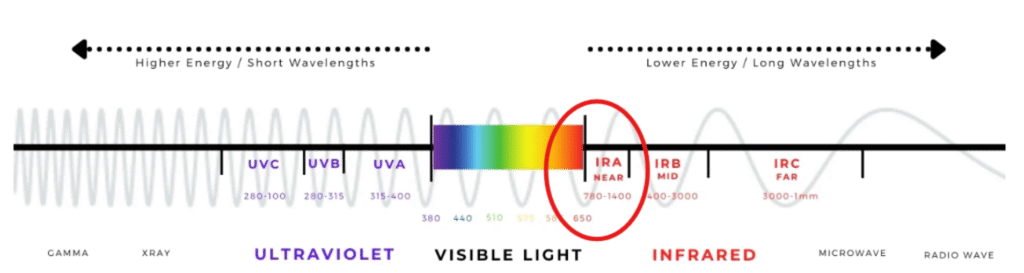
All wavelengths of light have their own effects and benefits, and this blog is going to focus on the healing effects of red and near infrared (NIR) wavelengths. Red wavelengths range from about 630 nm to about 780 nm, and NIR wavelengths range from about 780 nm to 1400 nm. These wavelengths are absorbed by Cytochrome C Oxidase in the mitochondria, with the effect of increased cellular energy (ATP) production, thus enhanced cellular function.
Photobiomodulation (PBM) is the therapeutic application of light to promote tissue repair, reduce inflammation, and relieve pain. PBM utilizes light sources like LEDs and lasers to induce biological responses without causing heat damage.
Longer Red and NIR wavelengths of light are very complementary to healing.
- The more shallow penetrating red wavelengths are absorbed more superficially by the blood, stimulating mitochondria which not only improves cellular metabolism but also releases nitric oxide to improve circulation. While all red wavelengths will provide some benefit, the most consistent that I see in the research for optimal healing and pain relief out of the entire Red range is 660 to 670 nm.
- The deeper penetrating NIR wavelengths activate mitochondria deeper in tissues for improved cellular energy and repair. These effects go beyond local tissue repair, with improved mitochondrial metabolic capacity impacting neural, cardiovascular, and immune function. NIR PBM consistently shows reduced inflammation and oxidative stress, enhanced cellular proliferation and migration, and accelerated wound healing and pain relief. While all NIR wavelengths will provide some benefit, the most consistent that I see in the research for optimal healing and pain relief out of the entire Near Infrared range is around 810 nm.
Shorter blue light wavelengths (400 to 500 nm) will be discussed in a few recommendations, as well. Please note that blue wavelengths are NOT healing wavelengths, but they do have some limited therapeutic benefits and should be used with care.
- Blue light has therapeutic potential in oral health due to its ability to kill bacteria, viruses, and fungi; as well as its activation of certain chemical compounds.
- Blue light, however, has a great deal of adverse effects on circadian rhythm, metabolic health, and eye health, so you want to be mindful of its use to minimize effects on sleep, systemic health, and vision. Minimize its use in the evening and always protect your eyes!
Let’s now dive into how I’d like for my patients to understand the healing power of light! PBM with red and NIR light can be very useful in promoting oral health and healing with frenectomies, oral surgery, periodontal disease, tooth sensitivity, post-operative sensitivity following restorative work, enhanced orthodontic treatment, TMJ issues, and much more.
Important considerations for optimal PBM therapy results:
- FREQUENCY:
Typically, wait 24 hours between most PBM therapy sessions. 3x to 5x/week will often be a very effective protocol for maintenance therapy. In acute cases where pain management and wound healing are at the forefront, then more frequent PBM therapy will be beneficial, with daily therapy often being ideal. - DOSE: Achieving the desired dosage of light energy for the specific treatment is dependent on time of treatment and Irradiance of your particular device.
Target Doses: In general, target dose for more Superficial treatment areas (skin) ranges from 3 to 10 J/cm². Target dose typically ranges from 10 to 60 J/cm² for Deeper treatment areas (joints, periodontal bone, etc).
- Application Time
is determined by Energy Density (Desired Dose or Fluence – J/cm²) and Output of the device (Irradiance – mW/cm²). The formula you can use to determine treatment times to achieve desired dose with your particular device is this:Dose (Fluence) = Irradiance x Tx Time
J/cm² = W/cm² x seconds
The Irradiance of your device will be reported in its manual. It will be reported in mW/cm2. It is important to realize in the equation above that the Irradiance needs to be converted to W/cm2. So, if your device Irradiance is 100 mW/cm2, then you will convert and use 0.1 W/cm2 in the equation.
If you feel like your math is not mathing;), you could use an online dosage calculator like the one in this link, and plug in your desired dose and the Irradiance to get the time needed for treatment…
——————-
IMPORTANT CAVEAT: Irradiance is typically reported as the measurement at the surface (meaning that the device is in or very near contact with the treatment area). Understand that your targeted treatment area is often not going to be at the surface of the device. For example, if you are treating the TMJ with the device held on the cheek, you are about 2 cm away from the inner area of the joint. Don’t get caught up in the details of this, just understand the effect that distance from target has on dose delivered to target.
Here is a simple chart to account for the decreased irradiance from beam spread associated with distance from target.
Distance % of original
1 cm 100%
2 cm 25%
3 cm 11%
4 cm 6%
5 cm 4%
If 2 cm from target with a device with reported Irradiance 100 mW/cm2:
Irradiance reaching target = Irradiance at surface x % at distance
25 mW/cm2 = 100 mW/cm2 x 0.25
When an intraoral tip is on the device, transmission loss is less. The transmission loss will typically result in a decrease in irradiance from 10 to 30 %. Therefore, when an intraoral tip is used, I would recommend to assume about 85% (or less) Irradiance from the end of the intraoral tip.
Irradiance at end of tip = Irradiance at device surface x 0.85
With a device with reported Irradiance 100 mW/cm2:
85 mW/cm2 = 100 mW/cm2 x 0.85
ANOTHER IMPORTANT CAVEAT: Keep in mind that it’s the Wild West out there. Some Red/NIR devices available out there are not third party tested, so their reported output (irradiance) is often nowhere near what they claim it to be… sometimes over-inflated by as much as 250%! If this is the case, desired dosage will not be reached with the calculated treatment time. That doesn’t mean that you can’t treat with these devices, but it does mean that you will not get an effective dose for treatment unless you know this and utilize a much longer treatment time than claimed. My recommendations are for those companies that I have researched and assured that their claims are backed up by third party testing.
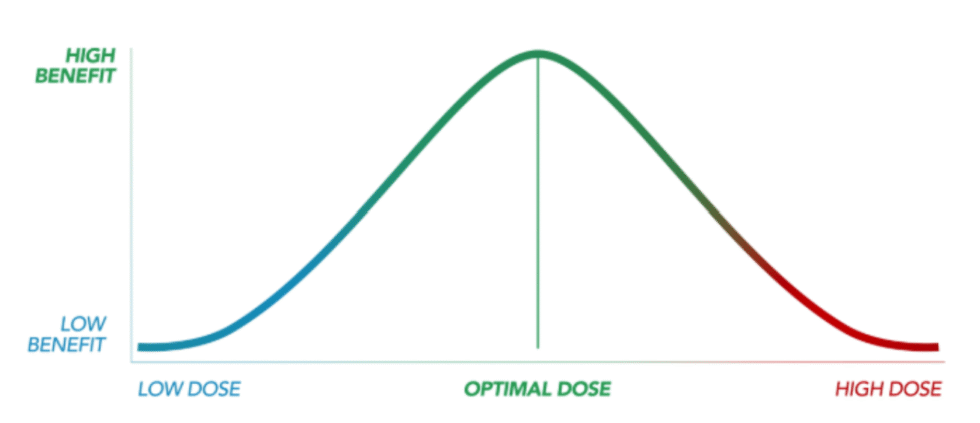
Understand the biphasic dose-response.
- Too little dosage will provide low therapeutic benefit, so you want to make sure you have a good quality device. One more time for the people in the back row;)…It is the wild west out there, and there are a lot of companies that are selling products with greatly exaggerated output, so I’ll provide some good quality companies and products for my recommended therapeutic uses.
- Too much dosage isn’t going to cause harm, but it can neutralize the benefit of the PBM therapy, returning you to a state of low therapeutic benefit.
My recommended devices and their uses:
***I have shared dosage calculations for each of the devices for dosage delivered in the duration of their automated timer when applicable, otherwise with the general recommended treatment times if they don’t have a timer. Remember that your target treatment area will be further from the surface of the device, so it will not get the full dose, but this gives you an idea of what to expect and how to calculate.
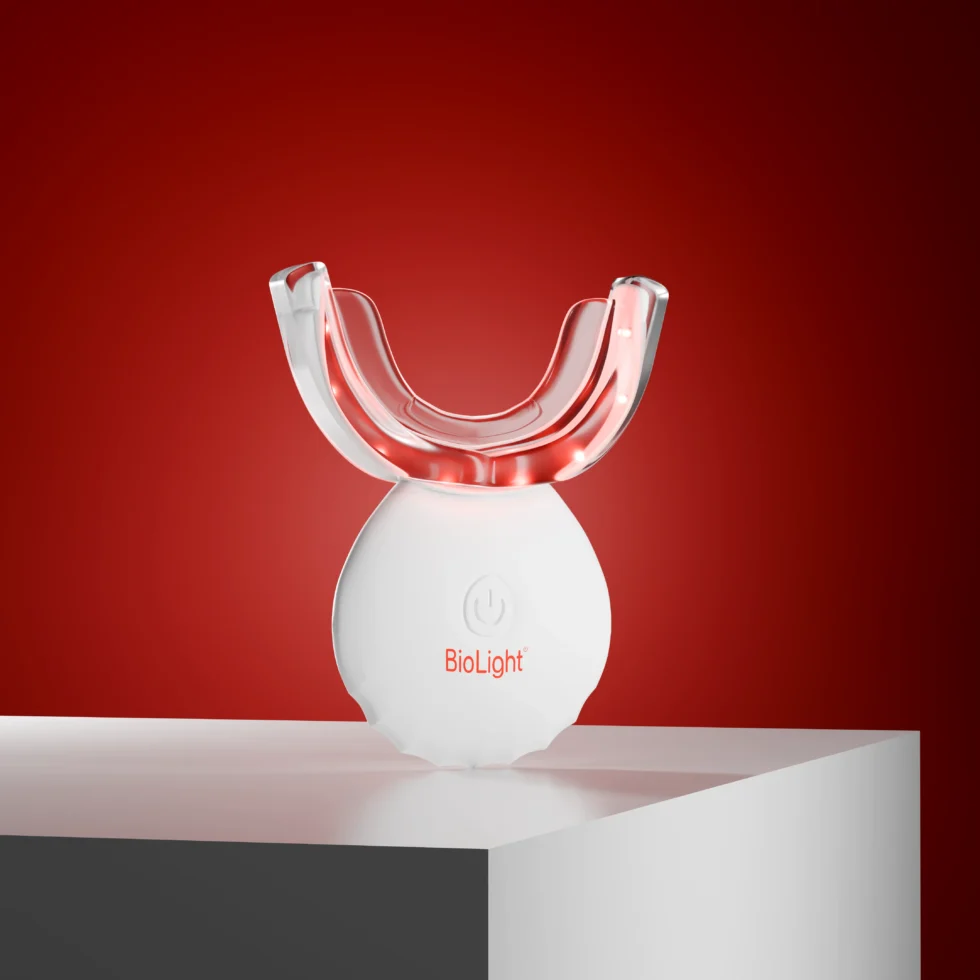
Biolight Guardian
**Code ‘drmindy’ for 15% off. My patients get a larger discount, as I am not affiliated with the company and have directed all available discounts to my patients.
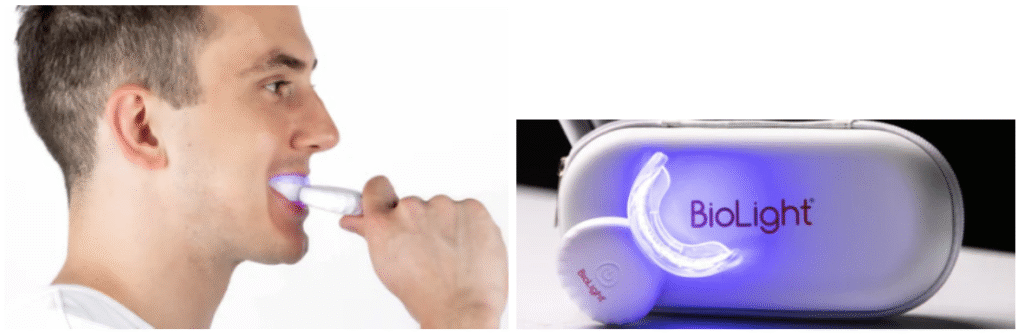
The Guardian has Red (630 nm) and NIR (850 nm) wavelengths. Irradiance is 20 mW/cm2. Automatic 16 minute timer.
The Dose for the 16 minute timer is 19.2 J/cm2.
(This is at the surface of the LEDs, so remember that the amount that reaches target tissues will be less based on distance.)
Dose (Fluence) = Irradiance x Tx Time
19.2 J/cm2 = 0.020 W/cm2 x 960 seconds
Orthodontic Patients: The red and NIR wavelengths are very effective in stimulating mitochondria in alveolar bone cells (osteoblasts and osteoclasts), allowing more efficient orthodontic movement of the teeth with enhanced bone development.
- During active orthodontic treatment, my ideal use would be this: At night before bed, with your aligners or light wire expansion appliance in place, use the Guardian for the full 16 minute timer.
- Do this once a day every day (or as close as possible).
Gingivitis or Periodontal Disease: Periodontal disease and gingivitis are inflammatory conditions, and Red/NIR PBM is a very effective anti-inflammatory tool to enhance the response to periodontal treatment. Shorter red light wavelengths are effective for gingivitis, and longer NIR wavelengths penetrate deeper for periodontal disease.
- During active inflammation (bleeding and/or puffiness of gum tissue are signs of inflammation), use for the full 16 minutes each day for 1 to 2 weeks.
- For maintenance treatment, use the full 16 minutes, 3x/week.
Generalized Tooth Sensitivity or Discomfort Following Dental Work: The NIR wavelength stimulates pulpal healing and repair, which in turn reduces tooth sensitivity. This device is particularly helpful if multiple teeth are sensitive.
- Use for the full 16 minutes. Do this 4x/week up to every day, dictated by the level of sensitivity.
Dry Mouth (Xerostomia): This is a side effect of many medications. Red/NIR wavelengths can help with stimulation of saliva. Wavelengths between 630 (Red) and 830 (NIR) nm have shown the most promise.
- Use for the full 16 minutes, 5x/week
Oral Lesions and Mucositis: Red/NIR wavelengths can be therapeutic for superficial gingival wounds like cold sores and canker sores, oral mucositis, and lichen planus.
- During active oral lesions, use the Red/NIR Mode for 16 minutes every day until resolved.
Biolight Guardian Plus
**Code ‘drmindy’ for 15% off. My patients get a larger discount, as I am not affiliated with the company and have directed all available discounts to my patients.
What is the difference between this and The Guardian? The Guardian Plus has the same Red (630 nm) and NIR (850 nm), with the addition of Blue (460 nm). There are 2 rows of LED lights, blue on one arch, red/NIR on the other. Due to this, it will always be best to flip the device in your mouth halfway through treatment to distribute the focus of energy to both upper and lower teeth. Irradiance is 20 mW/cm2 for blue and 28 mW/cm2 for red/NIR. Automatic 5 minute timer.
The Dose for the 5 minute timer is Blue 6 J/cm2 and Red/NIR 8.4 J/cm2.
(This is at the surface of the LEDs, so remember that the amount that reaches target tissues will be less based on distance.)
Dose (Fluence) = Irradiance x Tx Time
Blue: 6 J/cm2 = 0.020 W/cm2 x 300 seconds
Red/NIR: 8.4 J/cm2 = 0.028 W/cm2 x 300 seconds
Periodontal Disease: In cases of active periodontitis, there is a proliferation of pathologic anaerobic bacterial strains. This is when the blue wavelength of the Guardian Plus can be beneficial for its antibacterial activity to enhance the response to periodontal treatment. Research backed target blue dose (fluence) for antimicrobial effect is 20 to 60 J/cm2 .
- During active inflammation, use the Red/NIR/Blue Mode for 20 minutes each day for 1 to 2 weeks. (10 minutes with the device each way). We want Blue during this time for antimicrobial activity. We want Red/NIR, as well, to aid with inflammation.
- For maintenance treatment, use the Red/NIR Mode for 10 minutes, 3x/week. (5 minutes with the device each way)
Tooth Bleaching: This is another use for the Blue wavelength, as it activates the peroxides in bleaching gels to enhance bleaching results. Research backed target blue dose (fluence) for bleach activation is 20 to 40 J/cm2 .
- With the bleach in contact with your teeth, use the Blue Mode for 20 minutes of the time that you are bleaching, flipping the device over in your mouth halfway through.
- To help with sensitivity, follow this with the Red/NIR mode for 10 minutes after you finish bleaching. Again, flip the device over in your mouth for each of the 5 minute timers. You can do this for as many days as necessary to alleviate sensitivity.
SunPower LED Palm Ultimate

Hands down, this has been the most powerful and versatile device I have found. The price point is higher, but if it fits your budget, I would recommend this in a heartbeat. Not only do I have tremendous results with my TMJ patients with my device in the office, but I also keep a device at home that has been a game changer for healing family injuries and aches. It saved my son’s 2025 Competitive Gymnastics season after what could have been a season ending knee injury. Max used the Palm on his knee for 5 min Red/15 min NIR every day once a day- longer time for deeper penetration into the joint. The sports med physician could not believe the amount of healing that he saw less than a week after injury!
Separate Red and NIR modes. 660 nm Red Irradiance is 187 mW/cm2. 810 nm NIR Irradiance is 150 mW/cm2. Separate dedicated Red and NIR modes. No automatic timer. You can purchase an Intraoral Tip to attach to the device which could be beneficial in some specific situations, but I don’t think necessary due to the device’s large, effective, and very powerful treatment area at a whopping 40 cm2!
There is no timer on this device.
The Dose for 3 minutes of Red is 32.04 J/cm2 and for 9 minutes of NIR is 81 J/cm2. This would be a more desired treatment time for deep joints like the knee.
The Dose for 1 minute of Red is 10.68 J/cm2 and for 3 minutes of NIR is 27 J/cm2. This is adequate treatment time for most targeted treatment of the mouth and TMJ. It is OK to treat longer if you feel more benefit with even deeper penetration.
Dose (Fluence) = Irradiance x Tx Time
Red for 1 minute: 10.68 J/cm2 = 0.178 W/cm2 x 60 seconds
NIR for 3 minutes: 27 J/cm2 = 0.150 W/cm2 x 180 seconds
This Palm Ultimate has 25% more optical power than the company’s Palm Professional, so it is worth the investment to reach deeper areas faster. I prefer the 810 nm Palm Ultimate to the 1050 nm Superpalm because 810 nm has been the NIR wavelength most thoroughly and successfully studied for PBM. Longer wavelengths above 1000 nm may begin to be absorbed by cellular water, which may reduce desired absorption by mitochondrial Cytochrome C Oxidase. It is scientifically known that above 1350 nm is absorbed by cellular water and, while not scientifically verified below 1350 nm, I have heard some experts say that they believe that starting around 1000 nm, some water absorption begins that could reduce absorption by desired chromophore. Just want to give my personal reasoning for selection of this particular device.
Treatment protocol generally is as follows: Treat with Red first to stimulate circulation, release nitric oxide, and activate mitochondria in the blood for a systemic effect. Red will generally be one third of the treatment time. Treat with NIR second to penetrate deeper into the target tissue and stimulate mitochondria locally in the inflamed, injured, and/or healing tissue for improved cellular function and repair. NIR will generally be two thirds of the treatment time.
TMJ Pain and Dysfunction: The Palm Ultimate is by far the most effective device I’ve found for this, as its power for deep penetration and its large treatment area make it very efficient for the job! It is important to realize that TMJ dysfunction is a multifactorial issue, and this alone will not cure a TMJ problem, but it is an extremely effective adjunct to reduce discomfort.
- Hold the device to cover the TMJ and masseter area. This will be in front of the ear and down to about the jaw line, so it covers the whole joint system as just one treatment spot.
- 2 sites- one right and one left. 4 to 12 minutes treatment time per site. 8 to 24 minutes total.
- Treat for 1 to 3 minutes Red, then 3 to 9 minutes NIR over each joint.
- Do this daily during acute pain and 4x/week when controlled.
Healing After Laser Tongue Tie Release: The combination of Red and NIR wavelengths have shown accelerated healing, reduced pain, and improved epithelialization (greatly reduced scarring!) as compared to control groups in the research for oral wound healing following soft tissue surgery.
- Ideally, treat intraorally and extraorally.
- Extraorally, extend head to hold the Palm flat under the chin as close to the skin as possible. 1 minute Red. 3 minutes NIR.
- Intraorally, open your mouth and lift your tongue up. Hold the Palm over your open mouth. 1 minute Red. 3 minutes NIR.
- Do this every day for 1 week, then every other day for 4 more weeks.Treating for the full 5 weeks is helpful in the reduction of scar tissue formation.
Pulpal Healing Following Restorative Work or Trauma to a Tooth: Teeth can be sore and/or hypersensitive following restorative procedures like fillings and crowns or following dental trauma like a tooth getting hit with a baseball. PBM can be very effective in acceleration of relief with this. The Red will activate the local blood supply, then the deeper penetrating longer wavelength NIR light is going to be very effective at reaching the pulp tissue inside the tooth, allowing it to promote pulpal healing.
- Hold the Palm over the cheek/lips, directly in front of the problematic tooth or teeth. 1 minute Red, followed by 3 minutes NIR. You may treat longer with each if you find more relief with it, but this amount of time usually provides sufficient relief.
- You could alternatively utilize the Intraoral tip attachment if you have it and desire, for a more precise treatment area. Treat the tooth by placing the tip on the front side of the bone right over the tooth roots. This will allow the longer NIR wavelength light to penetrate through the root and the thin bone and stimulate pulpal healing. This however, is not necessary and people find relief with the simple method noted in the first bullet point
- Treat 1 x/day for 2 weeks, and as needed thereafter.
Tooth Sensitivity: Red and NIR light therapy for dentin hypersensitivity is effective and results can last for months (depending on oral pH balance), as shown in the research.
- Hold the Palm over the cheek/lips, directly in front of the problematic tooth or teeth. 1 minute Red, followed by 3 minutes NIR. You may treat longer with each if you find more relief with it, but this amount of time usually provides sufficient relief.
- You could alternatively utilize the Intraoral tip attachment if you have it and desire, for a more precise treatment area in the case of a single tooth. Treat the tooth by placing the tip right at the gumline on the front of the sensitive tooth.
- Treat 1 x/day for 2 weeks, and as needed thereafter.
Periodontal Disease: This large and powerful device can efficiently and effectively target the inflammation of and be an excellent adjunct in the treatment of periodontal disease. The red light will increase blood flow and the NIR will penetrate into the bone to promote cellular repair and healing.
- You can treat the whole mouth extraorally in 3 sites, being mindful to hold the device on the face over where the teeth and their bone lie. Over right cheek, over front lips, over left cheek. You can also do an additional treatment with the mouth open, placing device directly in front of it in order to treat intraorally.
- For each site: 1 minute Red. 3 minutes NIR.
- For the first 2 weeks, use daily.
- For maintenance thereafter, use 3x/week.
Pain Reduction Before and After Oral Surgery: Red will stimulate circulation to aid in healing. Then longer penetrating NIR (810 to 880 nm) wavelengths are going to be most effective for pain reduction.
- To avoid excessive bleeding, do not treat for the first 3 days following surgery.
- Hold the Palm over the cheek covering the area where the surgical site lies underneath. This will be the easiest way to do it.
- If you have the intraoral tip attachment, you could hold the end of the tip intraorally directly over the surgical site, but the extraoral application will be easier and work very well.
- Treat with 2 minutes Red, then 6 minutes NIR
- Before surgery: Treat daily for a week
- After surgery: Treat for a week, starting on day 4 following surgery, and as needed thereafter.
Discomfort Before and After Root Canals:
- Hold the Palm on the cheek over the area of the tooth.
- Alternatively, you can use the Intraoral tip, if you have it. Place the end directly on the bone of the front side of the tooth roots.
- 1 minute Red, 3 minutes NIR.
- Do this every day for a week before the root canal and every day for a week after the root canal.
Treatment of Oral Lesions: Red and NIR combo is best for treatment of oral lesions, such as aphthous ulcers (canker sores), cold sores, oral mucositis, and lichen planus. Research has shown significant reduction in pain, size, inflammation, and healing time of ulcers in the PBM group vs placebo groups.
- Hold the Palm over the cheek where the lesion(s) is(are) located.
- If it is just one lesion and if you have the intraoral tip attachment, you could hold the end of the tip intraorally directly over the lesion, but the extraoral application will be easier and work very well.
- Treat with 1 minute Red, then 3 minutes NIR every day for 1 week or until the lesion resolves.
Xerostomia (Dry Mouth): Near Infrared (NIR) longer wavelengths (810 to 830 nm), applied intraorally and/or extraorally, have consistently been very effective for improvements in salivary flow for those with health conditions or medication side effects causing xerostomia. The slightly shorter Red wavelengths (660 nm) have also shown some improvement when applied.
- The key to effective treatment is application of the therapeutic light as close to the glands as possible. Start with an understanding of where the main salivary glands (parotid, sublingual, submandibular) are located.

- Only 3 treatment sites with the Palm, due to its large treatment area. Right Parotid. Left Parotid. Under the chin with head extended back to get all submandibular and sublingual glands together.
- Perform PBM treatment of the salivary glands 3 x/week up to daily for 6 weeks.
- Treat each site for a total of 4 minutes. 1 minute Red, followed by 3 minutes NIR. This would be a total treatment time of 12 minutes.
- In addition to extraoral treatment of the sublingual glands, you could treat intraorally simply by opening the mouth, lifting the tongue (to get the glands under it), and holding the device directly in front of your open mouth. This would be the same 1 minute of Red and 3 of NIR.
Nasal and Sinus Congestion: Red and NIR improve oxygenation, reduce inflammation, and boost innate immunity.
- The nasal passage and both maxillary sinuses can be treated pretty efficiently as one site with the large treatment area of this device. Hold the device right over the center of the face, covering the nose. 2 minutes Red. 6 minutes NIR.
- If you have sinus congestion alone, treat separately as right and left over the cheek, just behind the nose. Treat the left and right sides each for 4 minutes (1 minute Red, 3 minutes NIR).
- Do this daily as needed.
Swollen Tonsils and Adenoids: With inflamed enlarged tonsils and adenoids, the healing Red and NIR wavelengths can be beneficial. There are many etiologies of swelling of these lymphoid tissues, so results will definitely vary and an anti-inflammatory diet is essential, but PBM will never hurt- it will only have the potential to help.
- With this big and powerful device, you can reach the tonsils and the adenoids to some degree simply by opening your mouth and holding the Palm right up to it.
- In this manner, I would recommend 2 to 3 minutes of Red and 6 to 9 minutes of NIR. Or as close to this as you can.
- Do this daily for 2 weeks.
- If you have the Intraoral tip, you can do a 4 minute treatment for each of the 3 sites. Or as close to this as you can.
- With the intraoral tip, treat the right and left tonsils as separate sites. Using the Intraoral tip, get the end as close as you comfortably can to the tonsil. Treat each tonsil for 1 minute Red, 3 minutes NIR. With the intraoral tip, treat the adenoids as one site by targeting the end of the Intraoral tip to the soft palate, as the adenoids lie just above the soft palate. Treat for 1 minute Red, 3 minutes NIR.
- Do this daily for 2 weeks.
Lightpath LED Diesel Torch
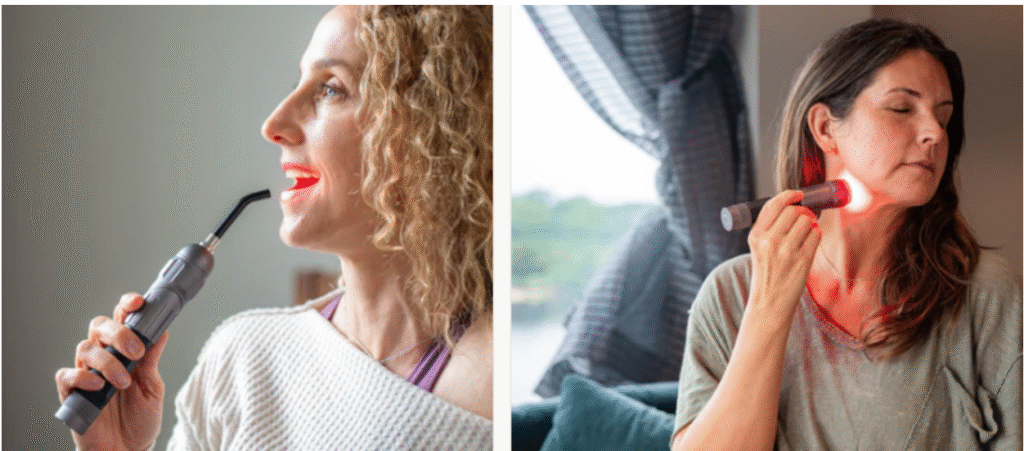
Upside? At this point, I find this to be the most cost effective option for higher output treatment in a number of situations. Downside? The treatment area is small, so only spot treatment is possible and it takes longer to treat larger areas as multiple sites. As a comparison, the treatment area of the Torch is only about 6 cm2, whereas the treatment area of the Palm Ultimate is about 40 cm2!
The half moon lens allows targeted treatment for skin/joint/muscle anywhere in the body by pressing it into the skin over the site. The intraoral tip is great for treating specific teeth or other intraoral sites with a more intense and effective dose. Outside of the oral and TMJ treatments I highlight below, the device can also be used for skin/muscle/joint issues throughout the body. Remember that the small size will require more treatment sites to effectively treat due to its small size. That being said, its output is good.
The wavelength combination is Blue (450 nm), Red (620 and 670 nm), NIR (810 nm). Automatic 6 minute timer. The unit claims 200 mW/cm2 output at the surface with no tip, but I have not seen third party testing for this. I have found third party verification from an outside company of 120 mW/cm2 at 2.5 cm and 100 mW/cm2 output from the intraoral tip.
The Dose for the 6 minute timer is 54 J/cm2.
Dose (Fluence) = Irradiance x Tx Time
Half Moon lens: 43.2 J/cm2 = 0.12 W/cm2 x 360 seconds
Intraoral tip: : 36 J/cm2 = 0.1 W/cm2 x 360 seconds
The three therapeutic modes are as follows: Mode 1: Red, NIR, and Blue. Mode 2: Red and NIR. Mode 3: Red only
TMJ Pain and Dysfunction: It is important to realize that TMJ dysfunction is a multifactorial issue, and this will not cure a TMJ problem, but the aim here is to reduce discomfort.
- Use Mode 2 Red/NIR combo.
- 4 sites– 2 right and 2 left. 6 to 12 minutes per site. 24 to 48 minutes total treatment time for both joints.
- Using the Half Moon lens, press it into the skin directly in front of the tragus of the ear, which will be directly over the jaw joint for site 1. Press it over the masseter, which is right in front of the angle of the mandible for site 2.
- Do this daily during acute pain and 4x/week when controlled.
Healing After Laser Tongue Tie Release:
- Use Mode 2 Red/NIR combo
- Ideally, treat intraorally and extraorally.
- Extraorally, press the Half Moon lens into the skin under the chin. 6 minutes.
- Intraorally, open your mouth and lift your tongue up. Hold the Half Moon lens just over the surgical site on the floor or your mouth. 6 minutes.
- Do this every day for 1 week, then every other day for 4 more weeks.Treating for the full 5 weeks is helpful in the reduction of scar tissue formation.
Pulpal Healing Following Restorative Work or Trauma to a Tooth:
- Use Mode 2 Red/NIR combo.
- Utilize the Intraoral tip attachment for more precise concentration of energy. Treat the tooth by placing the tip on the front side of the bone right over the tooth roots. This will allow the longer NIR wavelength light to penetrate through the root and the thin bone and stimulate pulpal healing.
- Alternatively, you can press the half moon lens into the cheek directly over where the tooth lies beneath.
- For each tooth, complete the 6 minute timer, 1 x/day for 2 weeks.
Site-Specific Tooth Sensitivity:
- Use Mode 2 Red/NIR combo.
- Place the Intraoral tip right at the gumline on the front of the sensitive tooth.
- Alternatively, you can press the half moon lens into the cheek directly over where the tooth lies beneath.
- Complete the 6 minute timer per site 1 x/day for 2 weeks, or until the sensitivity resolves.
Localized Periodontal Disease: This smaller device is effective at treating specific areas of advanced periodontal disease, in contrast to the previously discussed larger devices.
- Use the Intraoral tip directly over the bone in front of the desired tooth. Alternatively, you can press the half moon lens into the cheek directly over where the tooth lies beneath.
- Treat each site for 6 to 12 minutes..
- For the first 2 weeks, use Mode 1 Blue/Red/NIR daily.
- For maintenance thereafter, use Mode 2 Red/NIR 3x/week.
Xerostomia (Dry Mouth):
- See the photo/diagram in the section above for an understanding of where the main salivary glands (parotid, sublingual, submandibular) are located.
- Use Mode 2 for Red/NIR combo.
Perform PBM treatment of the salivary glands 3 x/week up to daily for 6 weeks . - 5 total sites. 6 minute treatment each. Total of 30 minutes treatment.
- 2 sites: Treat the right and left parotid glands (the small diameter of the device will require 2 extraorally with the half moon lens pressed into the skin in front of the earlobe.
- 2 sites: Treat the right and left submandibular glands extraorally with the half moon lens pressed into the skin of the floor of the mouth inside the mandible, just anterior to the jawline.
- 1 site: Treat the right and left sublingual glands extraorally as 1 site. Treat the sublingual glands extraorally with the half moon lens pressed into the skin of the floor of the mouth just behind the skin.
- As an alternative to extraoral treatment of the sublingual glands, you could treat intraorally as 2 sites. Treat the right and left sublingual glands intraorally with the intraoral tip directed under the tongue, right side then left side.
Pain Reduction Before and After Oral Surgery:
- To avoid excessive bleeding, do not treat for the first 3 days following surgery.
- Use Mode 2 Red/NIR combo Press the Half Moon lens on the cheek skin directly in front of the extraction site. Treat for 12 minutes
- Alternatively, you can use the intraoral tip and hold it right over the extraction socket and treat for the same amount of time.
- Before surgery: Treat daily for a week
- After surgery: Treat for a week, starting on day 4 following surgery, and as needed thereafter.
Discomfort Before and After Root Canals:
- Use Mode 2 for Red/NIR combo.
- Using the Intraoral tip, place the end directly on the bone of the front side of the tooth roots for 6 minutes.
- Do this every day for a week before the root canal and every day for a week after the root canal.
Treatment of Oral Lesions -Such as Aphthous Ulcers (Canker Sores) and Oral Mucositis:
- Use Mode 2 Red/NIR combo.
- Using the Intraoral tip, place the end directly in contact with the ulcer. Treat each individual lesion for 6 minutes, 1x/day every day until healed.
Nasal and Sinus Congestion: Blue light is beneficial for its antibacterial properties here. Red and NIR improve oxygenation, reduce inflammation, and boost innate immunity.
- Use Mode 1 Red/NIR/Blue combo.
- For sinus congestion, you will use the Half Moon lens. Press into the skin just inferior to the cheekbone, in the area above the upper molars. Treat the left and right sides each for 6 minutes. Do this daily as needed.
- For nasal congestion, you will use the Half Moon lens. Press over the side of the nose, right and left as separate sites. Treat each side for 6 minutes. Do this daily as needed.
Swollen Tonsils and Adenoids: Due to the bacterial nature of tonsillitis and adenoiditis, using anti-bacterial Blue light in addition to the healing Red and NIR wavelengths is desirable. There is only limited research of this specific treatment, but common sense with the therapeutic knowledge we have can be paired with the limited data available to recommend targeted therapeutic protocols
- Use Mode 1 Red/NIR/Blue combo.
- Treat the right and left tonsils as separate sites. Using the Intraoral tip, get the end as close as you comfortably can to the tonsil. Treat each tonsil for 6 minutes. Do this daily for 2 weeks.
- Treat the adenoids as one site by targeting the end of the Intraoral tip to the soft palate, as the adenoids lie just above the soft palate. Treat for 6 minutes. Do this daily for 2 weeks.
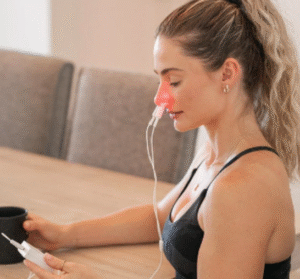
**Code ‘drmindy’ for 15% off. My patients get a larger discount, as I am not affiliated with the company and have directed all available discounts to my patients.
This is a highly specialized device with more limited uses, but it is a very convenient mode of treatment for those with chronic nasal and sinus congestion. It has two wavelengths, antibacterial Blue at 450 nm and healing anti-inflammatory Red at 650 nm. Unfortunately, there is no NIR wavelength at the time I write this.
3 Modes. M1 is Red/Blue. M2 is Red only. M3 is Blue only.
Nasal and Sinus Congestion: Blue light is beneficial for its antibacterial properties. Red reduces inflammation and improves oxygenation.
- Use at 100% intensity on M1 mode.
- One nasal probe will emit Red light, the other will emit Blue light. For this reason, remember to rotate the nasal probes halfway through treatment each time.
- The first week, start with 10 minutes total treatment time.
- The second week and thereafter, go up to 20 minutes total treatment time.
- Treat 4x/week
Great Resources to Learn More:
- Huberman Lab Podcast: Using Light (Sunlight, Blue Light & Red Light) to Optimize Health
- Dr. Glen Jeffery, PhD, from Stanford discussing red light therapy: Red Light Therapy Improves Mitochondria Function, Eye Health, And Lifespan: Glen Jeffery, PhD
- Dr. Jack Kruse, MD on the Take a Deep Breath Podcast: Health is about Light NOT Food
- Dr. Michael Hamblin, professor at Harvard and Principal Investigator at the Wellman Center for Photomedicine at Massachusetts General Hospital: Red LIght Science DEEP DIVE
- https://sunpowerled.com/research/
One more thing…
To maximize the benefits of photobiomodulation, be sure your body has what it needs to handle the increased cellular energy and efficiency.
- A nutrient dense anti-inflammatory diet is essential to reduce inflammation and maximize healing in all of these situations.
- Have proper B vitamin complex for ATP formation uptick.
- Healthy fats like fish oil for neuron formation.
- Antioxidants Vitamin C and CoQ10 to handle uptick in ROS from increased ATP formation.
- Good glutathione support, with sulfur rich veggies like broccoli, cauliflower, onions, garlic, etc..
Photobiomodulation is truly a remarkable therapeutic modality, and I encourage you to learn more about it. Aside from the oral and craniofacial benefits I detail above, PBM has so much benefit for mood, skin health, muscle recovery, vision, brain health, you name it. Use some of the credible sources that I share in the resources above and get after it;).
✌️